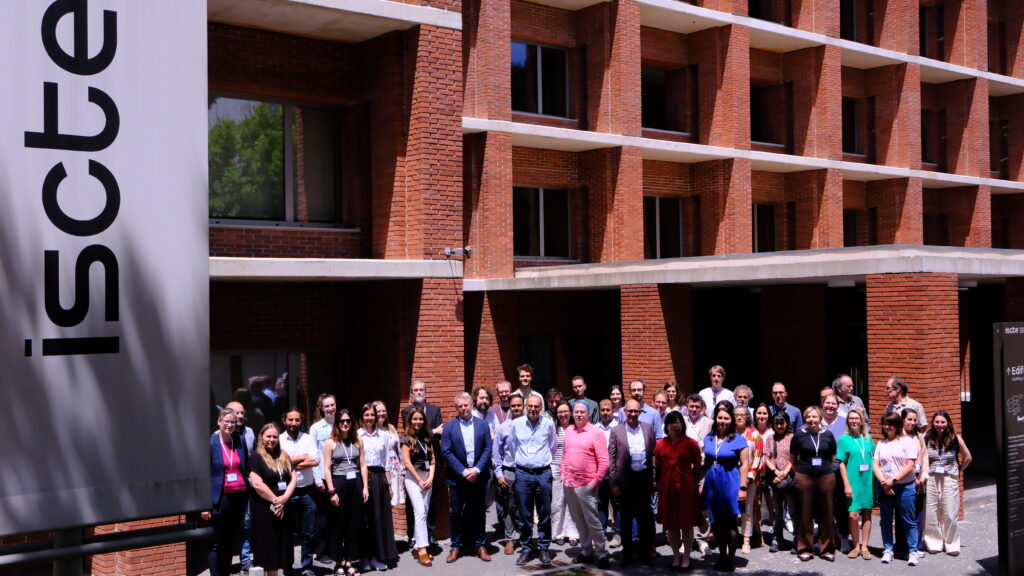
1-3 June 2026, the CANDLE consortium came together in Lisbon and online for its 2026 Annual Meeting, marking the project’s first year and setting the direction for the next phase of work. Hosted by ISCTE (Portugal), the three-day programme brought together more than 60 participants from the consortium, pilot National Cancer Data Nodes (NCDNs), European Research Infrastructures, policy, research, healthcare organisations, patient-related actors and European initiatives.
The meeting opened with a warm-up day dedicated to the CANDLE Maturity Model and the Portuguese oncology ecosystem. Participants discussed how the model can support NCDN development, reflected on pilot experiences from Finland and Spain, and explored individual maturity domains in an interactive world café. In parallel, Portuguese stakeholders exchanged on the national oncology research and care landscape, common needs and links to European initiatives such as CANDLE, UNCAN-Connect, ECHoS and EU-CiP.
The main event June 2 and 3 then focused on how CANDLE can help Member States develop flexible, EHDS-ready NCDNs that make cancer data more FAIR and usable for research. Sessions addressed the anchoring of NCDNs in EHDS developments, their value for Member States, real-life examples from Germany, Lithuania and Ireland, and the emerging CANDLE Resource Kit.
The final day broadened the perspective to the EU Cancer Mission, digital transformation, the UNCAN.eu and ECPDC ecosystems, and national examples from France, Portugal and Luxembourg.
Our 6 key insights:
- NCDNs should be positioned clearly within EHDS roles.
- The five NCDN functions provide a strong guide for implementation.
- Member States are progressing, but face common challenges around mandate, funding and fragmentation.
- Data holders are central to cancer data quality and reuse.
- UNCAN.eu is an ecosystem shaped by several complementary projects.
- User adoption requires attention to behaviour, workflows and coordination, not only technology.
These insights will guide CANDLE’s second year as the project strengthens its implementation support for Member States.